
RV Celtic Explorer sets sail on international North Atlantic research expedition to track ocean change
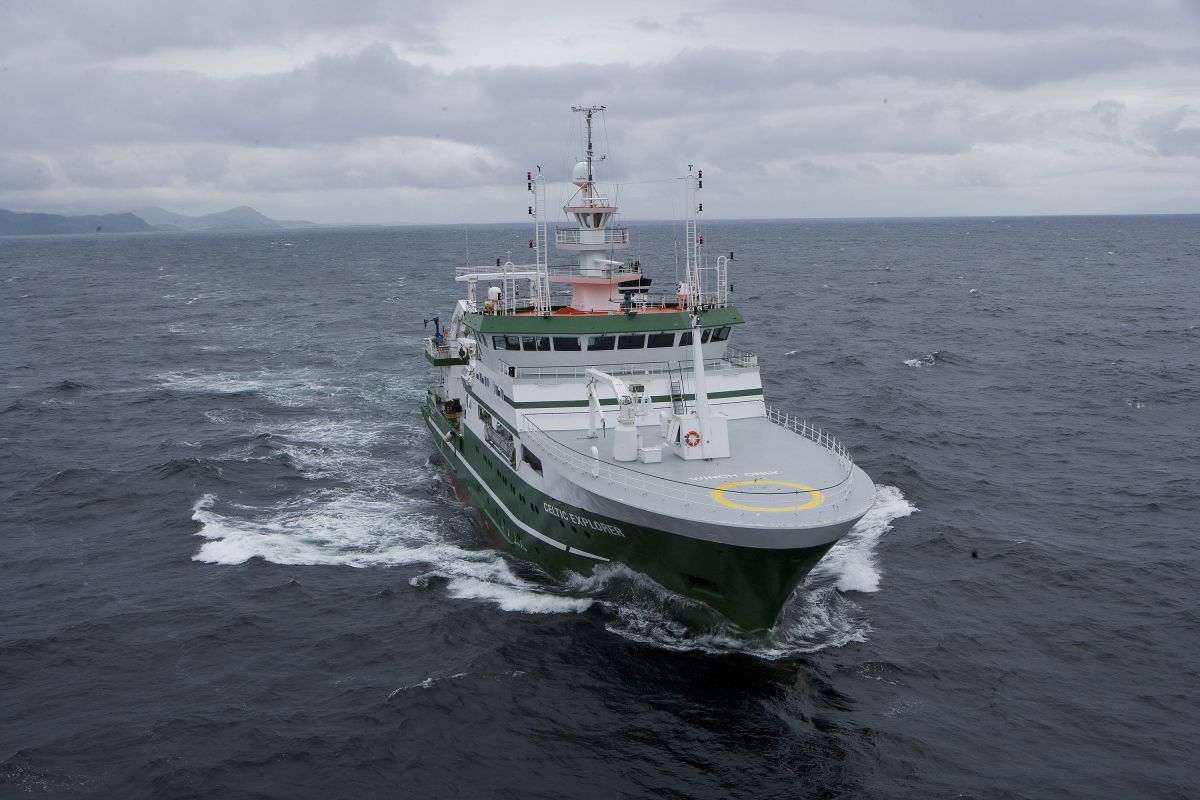
An international team of scientists has just embarked on a major research expedition aboard the RV Celtic Explorer, marking the first time Marine Institute research infrastructure has been accessed through the Horizon Europe AQUARIUS Transnational Access programme.
The team are involved in the ‘AR7E-2026’ survey which will conduct physical, biogeochemical and biological observations along a transect from the north-west of Ireland to Cape Farewell at the southern tip of Greenland, building on internationally recognised hydrographic transects that have provided climate-quality measurements across the Atlantic for decades (the GO-SHIP repeat hydrographic sections). By extending these long-term observations, the survey will generate new insights into the links between ocean circulation, climate, carbon cycling and marine ecosystems.
This survey highlights the important scientific research that is made possible by RV Celtic Explorer. The state-of-the-art research vessel is a critical asset, helping to generate a wealth of data that is used to advance Ireland's priorities across climate action and environmental protection, ensuring the sustainable management of its maritime territory. Alongside the expertise of its crew and scientists, it plays a pivotal role in deepening our understanding of the ocean.
Michael Gillooly, Director of Ocean, Climate and Information Services, Marine Institute, said: "The AR7E-2026 expedition demonstrates the importance of international collaboration and sustained ocean observation in addressing global challenges such as climate change, biodiversity loss and ocean health. We are delighted to see RV Celtic Explorer supporting this world-class research effort, generating vital scientific evidence that will deepen our understanding of the North Atlantic and inform sustainable ocean management both nationally and internationally."
The expedition is particularly timely as it contributes scientific knowledge from areas beyond national jurisdiction – the vast regions of the ocean lying outside any country's exclusive economic zone. As the international community begins implementing the landmark UN High Seas Treaty on Biodiversity Beyond National Jurisdiction (BBNJ), high-quality observations from these waters will play an increasingly important role in understanding, conserving and sustainably managing marine biodiversity. Such research provides the scientific evidence needed to support international cooperation in protecting the global ocean.
‘AR7E-2026’, led by Dr Yvonne Firing from the National Oceanography Centre (NOC), is the first Marine Institute research vessel survey to receive funding through the Horizon Europe AQUARIUS project. The AQUARIUS project, coordinated by the Marine Institute, brings together 45 partner organisations from across Europe to provide researchers with transnational access to an integrated portfolio of world-class marine and freshwater research infrastructures, enabling collaborative science to address pressing environmental challenges and support healthy, sustainable aquatic ecosystems.
The ‘AR7E-2026’ project brings together researchers from the National Oceanography Centre (UK), NORCE (Norway), the Vlaams Instituut voor de Zee (Belgium), the Centro de Ciencias do Mar e do Ambiente/University of Lisbon (Portugal), ETH Zurich (Switzerland), and the Hellenic Centre for Marine Research (HCMR). The expedition aboard the RV Celtic Explorer demonstrates how access to cutting-edge European research infrastructures enables international collaboration to strengthen long-term ocean observing systems and improve our understanding of the rapidly changing North Atlantic.
END
For more information, please contact:
Kathleen Sweeney e: kathleen.sweeney@marine.ie | m: +353 (0)87 094 5754
Sinéad Coyne e: sinead.coyne@marine.ie | m: +353 (0)87 947 7090
Communications Office, Marine Institute e: communications@marine.ie | t: +353 (0)91 387 200
About AQUARIUS
AQUARIUS is a four-year, €14.5 million project with the aim to provide access to a comprehensive and diverse suite of integrated research infrastructures to address challenges and explore opportunities for the long-term sustainability of our marine and freshwater ecosystems. Funded by the Horizon Europe program, AQUARIUS brings together researchers, institutions, and infrastructure providers to foster collaborative research efforts across Europe.
AQUARIUS has received funding from the European Union’s Horizon Europe Framework Programme for Research and Innovation under grant agreement No 101130915.
About the Marine Institute
The Marine Institute is Ireland’s scientific agency responsible for supporting the sustainable development of the State’s maritime area and resources. The Institute conducts applied research and provides scientific knowledge, advice and services to government, industry and other stakeholders and users. www.marine.ie